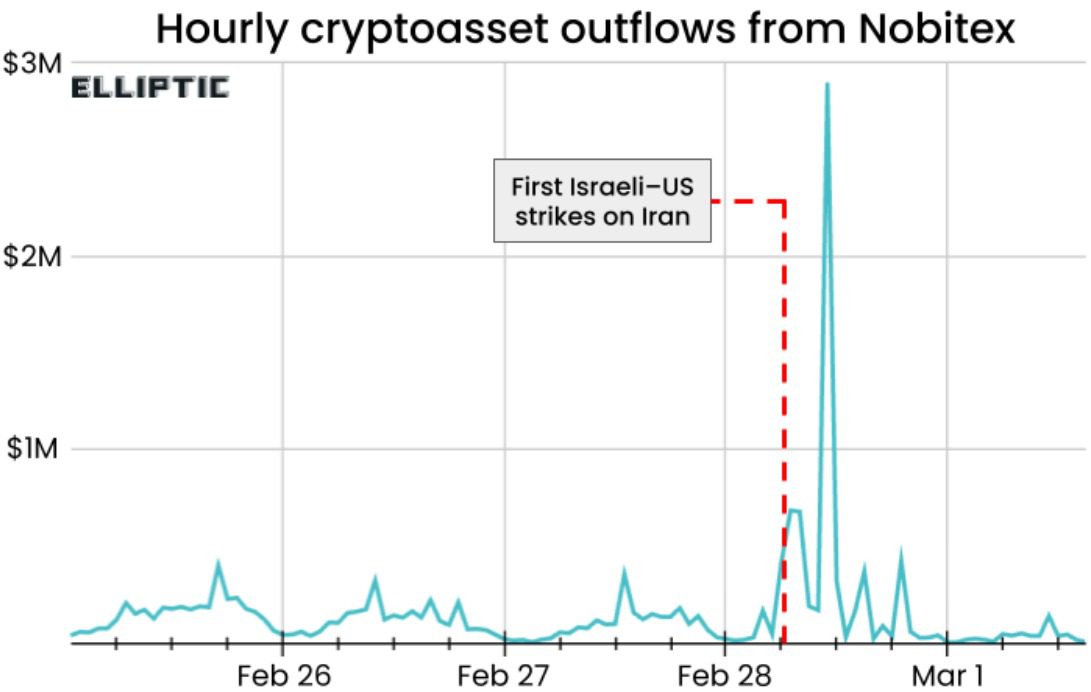
- On-chain analytics firm Elliptic has identified a 700% spike in outflows from Iran’s largest crypto exchange, Nobitex, starting just minutes after the first US-Israeli airstrikes on Saturday.
- Elliptic suggests the spike in outflows could signal a capital flight from Iran. Nobitex allows users to convert Iran’s fiat currency, the rial, to crypto, which can be more easily sent offshore.
- Nobitex is a key part of Iran’s crypto infrastructure but evidence suggests it is also used by the regime to skirt sanctions and has been linked to bad actors abroad in North Korea, Palestine, Russia and Syria.
Cryptocurrency outflows from Iran’s largest crypto exchange, Nobitex, surged over 700% within minutes of the first US-Israeli airstrikes on Tehran on Saturday night, Australian time, according to data from blockchain analytics firm Elliptic. At their peak, outflows from Nobitex on Saturday reached almost US$3 million per hour.
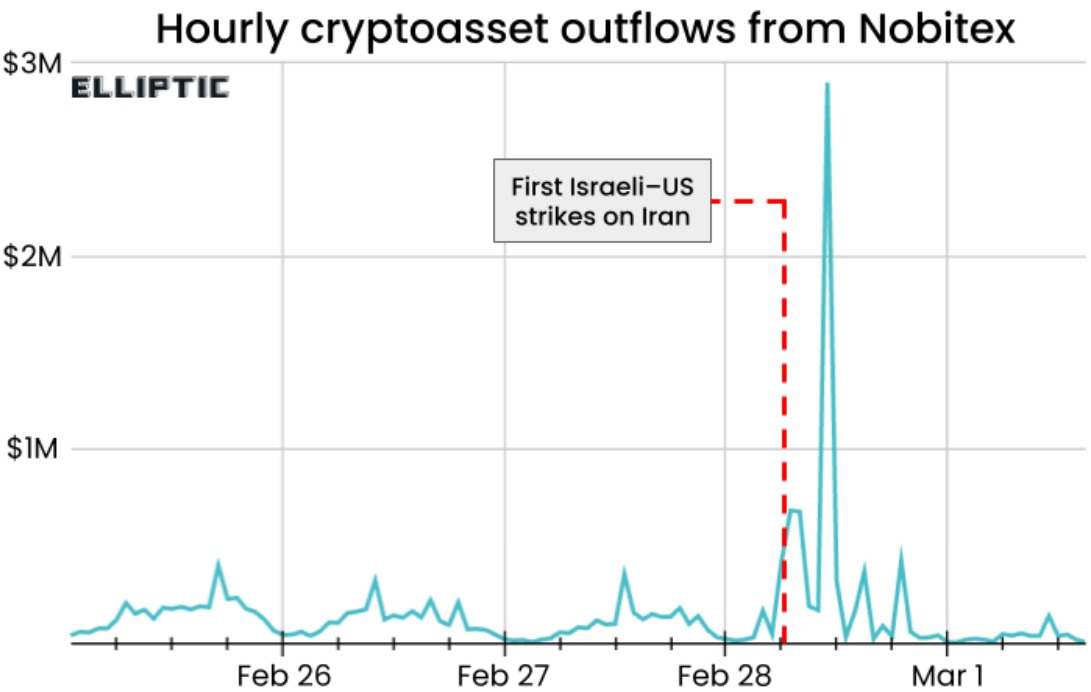
Elliptic’s co-founder and chief scientist, Dr. Tom Robinson, said that the spike in crypto outflows from Iran may indicate a capital flight from the country is underway. Iranians are able to use Nobitex to convert their holdings of the nation’s fiat currency, the rial, to crypto — which can then be sent to any crypto wallet, bypassing much of the scrutiny associated with fiat cross-border transfers using the traditional banking system.
According to Robinson, most of the transfers out of Nobitex headed to wallets associated with “overseas cryptoasset exchanges that have historically seen significant inflows from Iran.”
On January 9, there was another significant spike in outflows from Nobitex, coinciding with the large-scale anti-regime protests that swept the nation before being brutally put down by the nation’s hardline Islamist regime.
Other recent surges in outflows have coincided with the announcement of US sanctions, suggesting crypto may be being used to aid the regime skirt sanctions.
Related: Kalshi Faces Backlash After $50M Market on Khamenei’s Death Sparks Rule Dispute
Nobitex Has Ties to Regime and Terrorist Groups
Founded in 2017, Nobitex is now Iran’s largest and most important crypto exchange. According to Elliptic, in 2025, US$7.2 billion (AU$10.1b) worth of crypto was transferred to or from Nobitex by its over 11 million users. Despite being sanctioned by Western nations, Nobitex has grown quickly in the past few years, driven by rising inflation, economic sanctions and a lack of access to foreign financial institutions, including crypto exchanges.
In addition to helping Iranian citizens manage their financial affairs with restricted access to traditional finance, Nobitex is also believed to be heavily used by the Iranian regime to bypass international sanctions and to finance the Islamic Revolutionary Guard Corps (IRGC).
The ownership of Nobitex is also shrouded in mystery, but open-source investigations cited by Elliptic have identified links between some major shareholders and figures with close ties to the Iranian regime, including Seyed Mohammad Baqer Kharazi, a relative of Ayatollah Ali Khamenei who was killed in Saturday’s strikes, and close associate of Mohsen Rezaee Mirqaed, the founding commander of the IRGC.
Related: Crypto’s 24/7 Perps Turn Into Emergency Hedge as Middle East Tensions Rise
In its monitoring of Nobitex, Elliptic said it has observed “wallet behaviors and structural patterns…that bear similarities to activity previously linked to IRGC-affiliated networks.” While the firm said this doesn’t confirm funding links between Nobitex and the IRGC, it is a cause for serious concern.
Other analysis by Elliptic has also identified “wallet-level interactions” between Nobitex addresses linked to terrorist groups and rogue nations including Hamas, North Korean hacking groups, Syrian groups and Russian crypto exchanges tied to ransomware attacks.